

GR Crop School in session
Conservation District hosts event to help farmers improve soil health

by Kenny Fallon Jr.
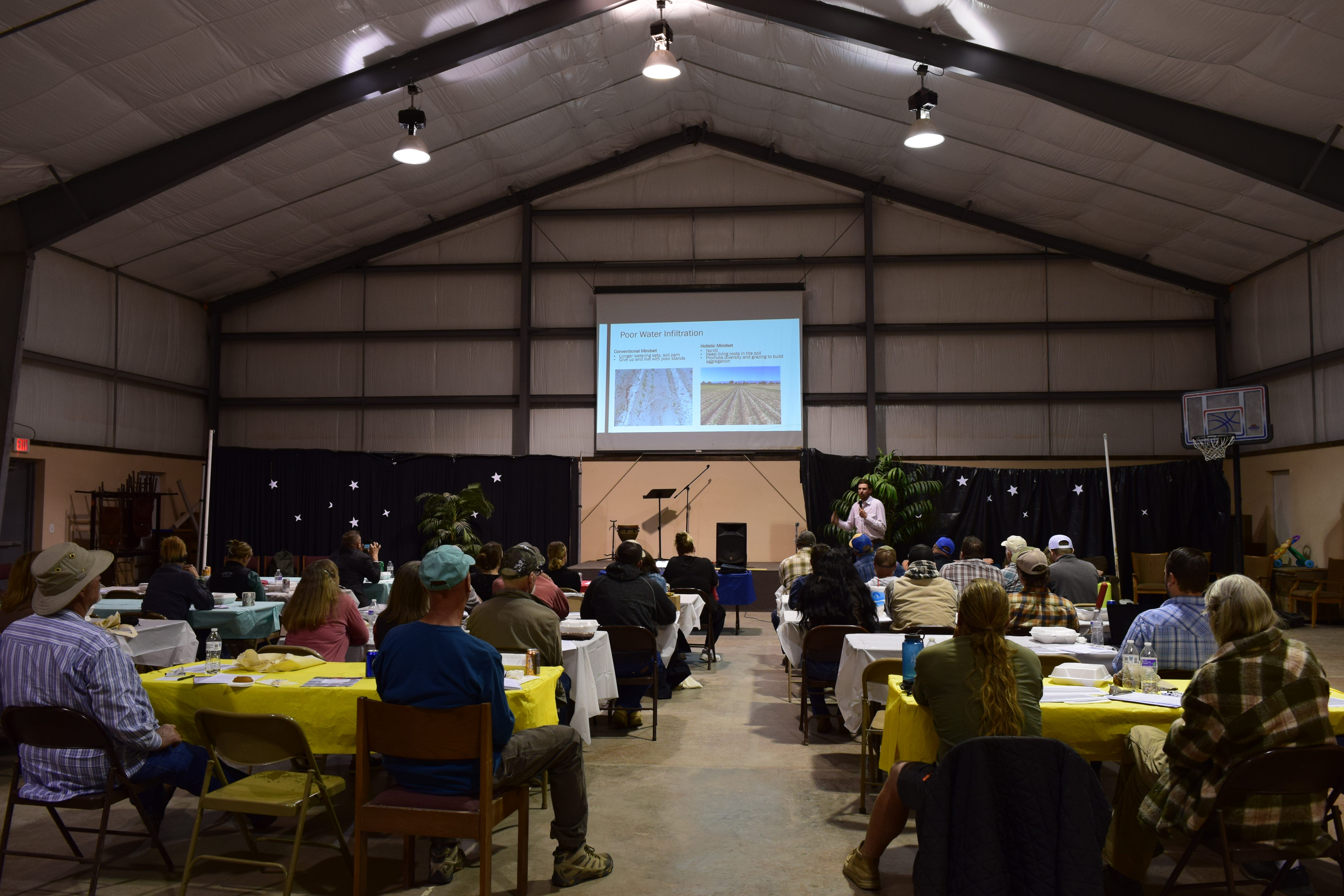
On April 17, the Green River Conservation District (GRCD) hosted over 30 people at the Bible Church’s event center for the Green River Crop School. The GRCD organizes educational events such as the Crop School and also rents out equipment to farmers. The district is one of many established in Utah since 1938 to “reduce soil erosion, improve water quality and wildlife habitat, conserve water, eradicate invasive weeds, [and] other issues that could impact the natural resources of Utah”, according to the Utah Department of Agriculture and Food (UDAF).
As Crop School attendees enjoyed a meal from Ray’s, which was sponsored by Western Ag Credit, GRCD Chairman Tyler Hunt introduced the evening’s focus on restoring soil health with a quote from Franklin Delano Roosevelt, that “the nation that destroys its soil, destroys itself”. After, he began the first of many opportunity draws, giving away prizes such as shovels, Maverik gift cards, and cuts of Bigelow Beef. Western Ag Credit representatives then reminded attendees of their loans for farmers and that they have programs geared especially towards young or beginning farmers. The next presenters explained their research and other programs available to support farmers. Milena Oliviera, a researcher at Utah State University (USU), has extensively studied dryland agriculture techniques in Utah, but traces her roots to a small farm in the drier regions of northeast Brazil, which are known for growing melons. She’s recently explored how grafting melons onto squash rootstocks might improve a crop’s yield and resistance to drought. Her lab’s research into grafting and user-friendly guides for improving vegetable production in Utah can be found at VegetablesProgram.Com.
Michele Schahczenski, the organic outreach coordinator for USU, then presented on the principles of organic agriculture, and how the definition of organic agriculture is regulated by the USDA. If farmers aren’t using certain materials, then the licensing can be pretty quick. UDAF has a program called Transition to Organic Partnership Program (TOPP) to help people through the process.
Katie Ottmann then explained UDAF’s Agriculture Voluntary Incentive Program (AgVIP), which she manages. AgVIP participants work with planners to discuss their farming operations, make an annual conservation assessment, explore new practices, and get a customized conservation plan. Successful participants get a bonus and those that stick to their conservation plans get payments each year. If they don’t follow their plans, there’s no penalties, they just won’t receive the incentive payments. According to Ottmann, in 2024 about 95% of successful participants wanted to re-enroll and felt it was worth their time. Applications for the next round close on May 30th at 5pm.
The last couple presenters explained the principles of soil health, and how they’ve been applied in the region. Tony Richards, the soil health program manager for UDAF, talked about how he and his team’s testing has shown promising results for interseeding and clay-coated seeds in Utah.
Philip Frank described the principles of soil health: (1) know your context, (2) minimize disturbance, (3) keep the soil covered, (4) maximize biodiversity, (5) keep a living root, and (6) integrate livestock; and then showed how he’s applied them on his farm in Loma, Colorado. He is co-founder and co-owner of Lifetime Ag, a company that sells cover crop and perennial seeds, sells and rents farming equipment, and consults on regenerative land practices. Frank calls his practices “regenerative” because he believes that healthy soil structure and biology will eventually take care of or lessen many issues usually addressed by increased tilling or the addition of more synthetic fertilizer. He said “you can solve problem[s] by backing up a few steps to what you did last fall”. Frank emphasized that this looks different on each farm, and that he’s more interested in helping farmers escape the “rat race” of needing to increase acreage and workers to sustain a business, than he is in any particular method of farming.
The GRCD holds meetings at City Hall at 5 PM on the second Monday of each month, and all are welcome to attend.